Febuary 2007
Vol. 5 - No. 02 | | 
| 
| 
|
The Irish Coast Guard 1852.
The Galway Mercury of Saturday says - "We are enabled to state, upon the best authority, that orders have been issued to the several Coast Guard stations
around the coast of Ireland to have all the men of that force, whose term of service does not exceed five years , in readiness to go on board ships of the line on the shortest notice" (1)
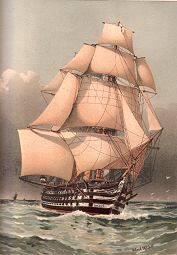
In Full Sail
Dublin, Saturday Feb.18 1854. On Tuesday evening Her Majesty's cutter Desmond arrived at Tramore East, and embarked a number of men of the Coast Guard from the neighbouring stations selected for service in the Baltic fleet. (4)
Irish Humour and Wit. "He who has never hoped can never despair" by George Bernard Shaw. |
|
| Coming in March Edition Coastguard Family Rescuers.
|
>>>>>>>>>>>>> |
| | Dear Friend, Welcome to the February edition of "The Coastguard Cutter".
| The Crimean War.
The coming of the Crimean War meant the full strength manning of the British Navy fighting and supply ships going to the War front in the Crimea.. Members of the Coastguard Service, as reservists, were manning Revenue Cruisers in home Channel waters and watching for ships heading for the Baltic Sea carrying goods to the Russian ports. Enjoy,
Tony.
| Sheerness 1853
A number of Coast Guard men, selected for service in the navy, being late men-of-war's men who have entered the Coast Guard, and now in this district, have received orders to hold themselves in readiness for being immediately draughted to ships in commission and fitting at this or any other ports. It is reported that 8,500 seamen, serving at present in the Coast Guard in the United Kingdom, are under similar orders. These alone it is calculated, will man 10 sail of the line with first rate experienced seamen accustomed to all naval discipline and customs. (2)
Deptford Feb.16 1854
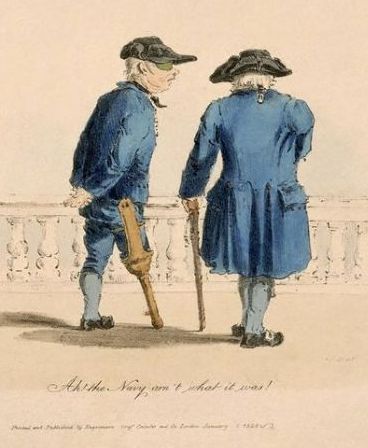
The whole of the pensioners of the Woolwich, Deptford and Greenwich districts, not serving afloat, assembled at Deptford Dockyard this morning, and Rear-Admiral M.T.F.Berkeley, C.B., with Captain Henderson, C.B., Controller of the Coast Guard, Colonel Tulloch, staff officer, commanding the out-pensioners of the London district, Major Forbes, staff officer of the pensioners of the Woolwich division, arrived about 10 o'clock and made a minute inspection of the pensioners in the Deptford division, and afterwards of the Woolwich division. The men found unfit received a card to that effect, and were to be allowed to return to their work in the dockyard, or in any place where they were employed. The men found capable of service are to hold themselves in readiness to serve in the room of the men of the coastguard who have been draughted for active service at sea. (3)
The Crimean War and the Coastguards. 1854 The Crimean War and the Coastguards. 1854During the war, 3,000 men of the Coastguard were drafted to the Fleet. The Revenue Cruisers were sent to intercept the enemy’s shipping in the Channel and in this they were remarkably successful. Parliament was told in 1856 that the cruisers had captured eleven vessels and that eight had been condemned. Their success was due to information supplied by consular officials in neutral countries. The British Consul in Oporto reported that ’during the last six months four vessels arrived under the Russian flag and left under the Hanovarian flag. Without a change of master or crew’ A Revenue boat from Folkestone, under Lt. George Durbin detained the 400 ton Russian barque ‘Kamschatka’, from Cadiz for Elsinore having a crew of 15 men, with a cargo of salt. In April 1854 the Spithead Revenue cruiser ‘Argus’ boarded and detained the Russian barque ‘Froija’ bound for the Baltic with a cargo of salt.Four days later the same cruiser under Commander Grandy detained the ‘Livonia’ also laden with salt. Two days later the Revenue Cruiser ‘Petrel’ under John Hughes, off St. Catherine’s Point, boarded and detained the barque ‘Fama’ of Wasa from Sardinia with a cargo of salt. The Revenue Cruiser ‘Lion’ captured the Russian brigantine ‘Johannes’, from Cadiz bound for Elsinore with a cargo of salt. This brought the total captures in one week to four and deprived the Russians if not of contraband stores of war, of a large quantity of salt. Before the war ended the enemy had lost another seven vessels to the Revenue cruiser patrols, again mainly loaded with salt. (5) |
| | Message in bottle. 1850.Letter to the Editor Sir - I beg to enclose the accompanying paper, extracted from as bottle picked up this day by one of my crew. A copy of the paper in which it is first inserted as an acknowledgement of its receipt will oblige. Your obedient servant W.T. Smith, Co. Coast-guard station, Hope Cove, near Kingsbridge, Devon. The paper read "We the passengers and crew of the ship' Harpley', bound for Australia, enclose this paper to inform our friends that we are half-starved on a raft, having drunk the contents of this bottle, the only thing we have drunk for 24 hours. The vessel sprung a leak, and foundered September 24, 1850.Courtenay Fowell" (8)
Serious Affray with Smugglers at Budleighsalterton. 1835. At 1 o’clock on Wednesday morning last, Lieutenant Clay, R.N. of the Coast Guard station, observed a boat unloading near the beach, at the back of the village. He fired a pistol which brought the Chief boatswain, John Bachelor, to his assistance, and they then attempted to prevent the smugglers from landing their cargo; on which they were attacked by a party armed with long bludgeons and fire-arms. A desperate struggle ensued; lieutenant being bound by the hand and foot. Was finally overpowered, and beaten till insensible. The chief boatswain seeing this and having received a blow which rendered his left arm useless escaped to a little distance, and ignited a blue light to alarm the coast; upon which the smugglers retreated, leaving their boat and 52 tubs on the beach. Both Lieutenant Clay and the chief boatswain were much hurt. (Western Luminary) (9) |
| | | | R e v e n u e F l e e t N e w s | 
|
Ship News Kinsale 27th.December. 1849.The brig 'Commerce' of Kincardine, Scotland, master from Liverpool for Trinadad with a general cargo was towed in here at 9 pm. by the 'Hamilton' Revenue Cruizer, Captain Triphook, having lost her main-mast, boats, cambouse, compasses, bulwarks and decks swept, while lying-to in the gale of Tuesday the 26th.inst. The cruizer fell in with the wreck off Galley Head and took her in tow for Cork, but owing to the winds coming against them (S.E.) they barely fetched around the Old Head, and at 9 o'clock came in here and anchored off the town.This is the second distressed vessel within the last fortnight that the 'Hamilton' has rendered assistance to, having rescued four of the crew of the barque 'Severn' of London, which vessel was driven from her anchors and stranded in the Courtmacsherry Bay during the heavy gale of the 15th.inst., when two of her crew were drowned.(6)
Capture of a Smuggler 1830. That very active and intelligent Officer, Captain Burke, of His Majestie’s Cruiser ‘Kite’ has brought into the Royal Harbour at Kingstown, a smuggling vessel with a crew of 6 persons, having on board 500 bales of contraband tobacco, concealed under salt, captured by him off the coast of Scotland on the 23rd.inst. (7)
| | |
References : - The Times, London 16 January 1852.
- The Times, London 8 June 1853.
- The Times, London 17 February 1854.
- The Times, London 20 February 1854.
- “Shipminder” by Bernard Scarlett.
- The Evening Freeman Thursday 4th.January 1849.
- Morning Register 27 Oct. 1830.
- The Times, London 1 October 1850.
- The Times, London. 11 December 1835.
|
© 2001-2007 [coastguards of yesteryear] |
Powered by HobbySites.net
|
|


 Posted by Tony
on June 17 2007
Posted by Tony
on June 17 2007



 Henry Bray, Chief Officer, Gr...[6830]
