January 2007
Vol. 5 - No. 01 | | 
| 
|  |
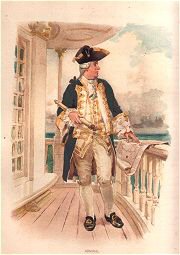
Navy dress Admiral
Frederick Corry, Chief Officer of Coastguards at Cleggan Bay, Galway, wrote to the Board of Public Works in August 1831 ‘pointing out the distress of the poor and recommending the construction of public roads, as well as the encouragement of the fisheries, by erecting piers, supplying fishermen with boats and nets, and by setting up small salt stores along the extreme shores of Conemara.’ The Board’s response was that Corry’s ‘Suggestions [were] without any specific application. No funds available.’
July 1873.
Notices have been posted in the various police barracks offering a reward for the capture of a boy named Samuel Craig, a pupil on board the ‘Gibraltar’ training ship, who escaped on the morning of the 30th June. The boy was described as being eleven years old and 4ft.6ins. in height. He wore the training ship apparel. (2)
Irish Humour and Wit. Do not resent getting old, many are denied the privilege. |
| Unsubscribe
| Coming in February Edition Woolwich Pensioners to take over from Coastguards.
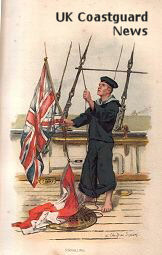
| 
|
| | Dear Friend, Welcome to the January edition of "The Coastguard Cutter".
| Happy New Year.
Another New Year starting for the 'Coastguard Cutter' to bring you bits and pieces of Coastguard goings-on in the past. Four years have passed since our News-Letter came into being and we would like to thank our readers for their help and support which is much appreciated. Roll on 2007. Enjoy,
Tony.
| Tuskar Rock.
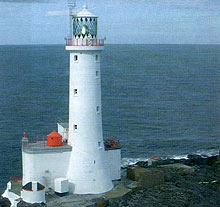 Of all the lighthouses on our coasts the Tuskar, seven miles off the South-East tip of Ireland, must be more familiar to more Irish people than any other. It lies directly in the path of all sea-traffic entering, or leaving, the ports of Rosslare Harbour and Wexford. Millions of emigrants from, quite literally, every county in Ireland, have been through Rosslare, outward and inward bound, passing, at a safe distance, the flat islet on which the massive granite tower stands most of them unaware of the treacherous rocky shoals that plague this Wexford coast; shoals which have probably caused more wrecks than any other navigational hazard on our seaboard. (1) Of all the lighthouses on our coasts the Tuskar, seven miles off the South-East tip of Ireland, must be more familiar to more Irish people than any other. It lies directly in the path of all sea-traffic entering, or leaving, the ports of Rosslare Harbour and Wexford. Millions of emigrants from, quite literally, every county in Ireland, have been through Rosslare, outward and inward bound, passing, at a safe distance, the flat islet on which the massive granite tower stands most of them unaware of the treacherous rocky shoals that plague this Wexford coast; shoals which have probably caused more wrecks than any other navigational hazard on our seaboard. (1)
Leggin' It!
I don't know which station they were at in Wexford but this story may point to it. My Grandmother used to tell about the day she was almost stranded on a desert island. It appears that when she was a small child, she and her elder brother were playing in a boat at a jetty.
The rope became unfastened and the boat was swept out to sea with the two children on board. Someone spotted them and gave the alarm. Great Grandfather had to get the men together and they put to sea in another boat to rescue the children before they were swept onto rocks. She called them the Tusker Rocks and I checked the Internet to confirm they are located of the coast at Wexford harbour.
She also spoke of shipwrecks on the Tusker Rocks and I remember well that a Great Aunt had a large burnished copper kettle that had apparently been washed ashore from one of these wrecks.
Another story from this part of the world involved an old woman who was a beach comber and she used to forage for wreckage. One day a decomposed seaman's body was washed up on the shore complete with a pair of seaman's boots.
The old woman pulled the first boot off without difficulty but when she tried to get the second one off she had problems. She pulled and pulled again and then pulled so hard that the boot with the leg still inside came away. She let out a shriek and ran off as fast as she was able to. It was some time before she ventured back on the shore. (3)
THE TUSKAR FIASCO or “ Will you look after our casks of Brandy till we return?”
On a fine morning in 1821, the cutter ‘Shark’, out of LeHarve, made landfall off Tuskar Rock Lighthouse, seven miles from Wexford, about 3 a.m. The skipper intended running up to Wexford Port, but, seeing Coastguard and Customs Officials in a launch patrollong the entrance to the channel, he ‘wore’ the ‘Shark’ into the ‘cothole’ on the Rock and landed, in the half light, according to his unofficial manifest, “a large cask and several smaller kegs of French brandy, 40 pounds of sperm candles, a tin box of playing cards, and several other excisable commodities.”
He explained his predicament to the two Lighthouse keepers, Michael Wisheart and Charles Hunter, ‘buying’ their confidence and collusion by promising them “a present”. On his return to claim the goods, if they were untouched. He then sailed up to Wexford, was overhauled by the Coastguard and Customs Officers, and searched. Nothing was found.
The ‘Shark’ lay – up in Wexford for a few days, during which time the skipper made plans to return to the Tusker Rock. He had a whaleboat on land at Ballytrent ready to make the run to the Rock One of his men kept a look-out for patrolling Coastguards. Leaving Ballytrent the smuggler was surprises to find no light on Tusker. On reaching the Rock he entered the tower where he found the two Lightkeepers; “Hunter dead drunk on his back, and Wisheart in the same state on his side.” They had ‘tapped the Admiral’ – broached the brandy cask – and had, to judge from the level remaining, been imbibing heavily. The smuggler left them to their slumbers and ran what remained of his cargo to Ballytrent. By an extraordinary coincidence, that very night, a wild, wet night, King George IV, aboard the Royal Yacht, in convoy with some ships of the Fleet, was en route to Kingstown. When they failed to find the Tuskar light, they were very perplexed and ran for shelter to Milford Haven.
An immediate examination was ordered into the affair, and, on 23rd.October 1821, the following resolution was made at a meeting of the Corporation in the Ballast Office, Dublin.
“An examination having taken place into the conduct of Michael Wisheart and Charles Hunter, relative to a Smuggling transaction at the Tuskar Lighthouse, it was resolved that; In consequence of the inattention of Michael Wisheart to his charge at the Tuskar Lighthouse, a quantity of contraband goods were deposited on the Rock, and of which he neglected to acquaint the Officers of the Board, to remove him from the situation of First Light-keeper, and that he be placed as second in some other lighthouse. It was also resolved that; Charles Hunter (Assistant Light-keeper at Tuskar), having permitted the landing of these goods, that he be removed from the situation of a light-keeper; and that he may hereafter be employed as a working blacksmith (from which employment he had been taken into the Lighthouse Service).”
Charles Hunter returned to work, as a blacksmith, and gave many years of loyal service there. Alas, poor Wisheart Was sent to the Skellig’s Rock, a place that was inhospitable and difficult of access. For a while his main off-duty occupation seemed to be ensuring that his cow had enough grass from the wind-swept rock. Cutting grass one day, near the cliff’s edge, he fell over and was killed. So ended this tragic-comic episode. What if the Royal Yacht had run aground on the this dangerous coast ? (1) |
| Smugglers Affray. 1832
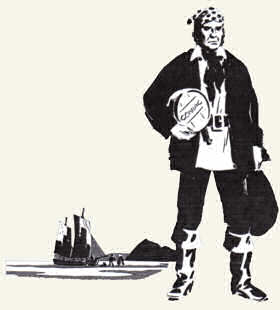 At about three o’clock on Wednesday morning, a terrible and fatal affray took place at Worthing, between a part of the Coast-Guard situated there, and a large party of smugglers and batsman. The attention of two of the guards, Carter and Richards, was attracted by a boat making rapidly for the beach, immediately upon perceiving which, they fired their pistols. The report of the pistols was immediately followed by a simultaneous rush of between 200 and 300 men to the beach, the boat at the same moment coming to land. After having fired repeated signals, they were joined by two or three more of the guard and instantly commenced a pursuit down the High-Street, whither the smugglers were in full retreat. They were, however, flanked by a desperate and determined body of batsmen, who repeatedly attacked the officers with stones and staves alternately attacking and retreating, and keeping their opponents at bay till they reached the termination of High-Street, and the entrance to the fields and pathway leading to Broadwater. At about three o’clock on Wednesday morning, a terrible and fatal affray took place at Worthing, between a part of the Coast-Guard situated there, and a large party of smugglers and batsman. The attention of two of the guards, Carter and Richards, was attracted by a boat making rapidly for the beach, immediately upon perceiving which, they fired their pistols. The report of the pistols was immediately followed by a simultaneous rush of between 200 and 300 men to the beach, the boat at the same moment coming to land. After having fired repeated signals, they were joined by two or three more of the guard and instantly commenced a pursuit down the High-Street, whither the smugglers were in full retreat. They were, however, flanked by a desperate and determined body of batsmen, who repeatedly attacked the officers with stones and staves alternately attacking and retreating, and keeping their opponents at bay till they reached the termination of High-Street, and the entrance to the fields and pathway leading to Broadwater. Here the officers were joined by Lieutenant Henderson, the Commanding officer of the station, and a most desperate affair began. Lieutenant Henderson, the moment they rushed upon him, ordered his men to fire, which they had scarcely had time to obey, when they were closed upon, and knocked down by the bats of 20 or 30 men, who continued to lay on most unmercifully, till they had completely incapacitated them from molesting them further. Of the smugglers, William Cowardson was found dead in the field; one man was found shot through the thigh; another in the foot; while a forth had had his shoulder laid open by a sabre wound. Several men were carried off in a disabled state, by different individuals who were awakened by the conflict; but as yet no one has been apprehended. On the part of the Coast Guard, the following wounds were received:-Lieutenant Henderson had his left arm broken; in two places, his ear cut open, and his head and body much bruised, Parrot, one of the men, has a rib broken; Clarke, his breast bone fractured by a stone which struck him as he was getting over the wall. The other men were also maimed in some way or another. An inquest was held at the Anchor Inn, on Thursday evening, J.L.Ellis Esq., coroner, upon the body of William Cowardson, and, after an examination of different witnesses, the jury found a verdict of “Justifiable Homicide” and expressed themselves completely satisfied that the conduct of the officers was completely authorised, and in a high degree honourable to them, on account of their intrepidity.
Brighton Herald. (3) |
| | | | R e v e n u e F l e e t N e w s | 
|
Shipwreck.
Early on Monday morning during a heavy gale the schooner ‘Thistle’ belonging to Watt and Perry of Glasgow, in running for Innislyre Harbour in Westport Bay, ran ashore under Innisgarth Lighthouse where they were paid every attention by Mr.M’cullagh, the Light-keeper. In a short while after, the vessel struck, the Coastguard boat belonging to Innislyre, under the orders of Mr.M’Gillicuddy, Chief Officer of the station with some men of the ‘Hamilton’ Revenue Cruiser, succeeded in saving everything belonging to her, and were employed in discharging her cargo, consisting of coals, but the vessel it is feared, from the late heavy gales, must become a total wreck. (Mayo Constitution) (4)
Officer Retiring the Coastguard Service.
Chief Officer Barrett, in command of the Coastguard station at Arklow, retires on good service on the 15th.inst. Mr.Barrett has been with the Navy and Coastguard up to 40 years having joined the ‘Hawk’ at Queenstown in 1860. After a considerable record in England, principally in Devonshire and Dorset, he was transferred to the command at Arklow which he has held for the past seven years and a half. In adition to the ordinary Coastguard duties the Chief Officer of the Arklow station has to look after the shipping and customs duties, which necessarily impose additional official responsibility. Mr.Barrett discharged these varied duties in the most satisfactory manner, both to the authorities and the public. He was brought largely into contact with the fishing people of Arklow, and his consideration and courtesy obtained the recognition of their respect. By the general people in Arklow, Mr.Bennett has been held in the highest esteem and their best wishes will be extended to him on his retirement. (5)
| | |
References : - Freemans Journal Friday 26 December 1862.
- "Shipwreck" by William Webb.
- The Times, London 27 February 1832.
- Evening Freeman Thursday 15th.March 1832.
- Wicklow People Saturday 8th.March 1902.
|
© 2001-2007 [coastguards of yesteryear] |
Powered by HobbySites.net
|
|


 Posted by Tony
on June 17 2007
Posted by Tony
on June 17 2007



 Henry Bray, Chief Officer, Gr...[6831]
