
Cry of Help Not every call needs the calling out of lifeboats, helicopters and aircraft. At 0500 hours on a cold winter's morning the Coastguard on duty at Kirkwall heard a cry for help over his radio. He immediately replied, 'What is your ship's name and position? What assistance do you want? The reply came back, 'This is the trawler 'Clova'. I am at Kirkwall Pier. I have got myself locked into the wheelhouse and can't get out!' (2)
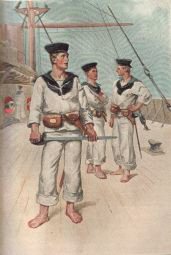
Boarding Party
A Well-fed Pauper. 1865.
There is at present in the Rathdrum Workhouse a Pauper Inmate named Curran, he is a young man and rather delicate looking, his appetite can scarcely be satisfied, the following being his allowance per day viz.- Six pounds of white bread; six pounds of meat and vegetables in proportion; six bottles of porter; one gallon of new milk, and an unlimited quantity of stirabout made of patent oatmeal and rice; he also drinks in addition to the above two gallons of water, he is under hospital treatment, and on the Ovoca Electoral division. (3)
Wit & Wisdom of Ireland The little boy had been sitting close to the confession box door for a long time before father Casey noticed him. 'Have you been listening to confessions all evening?' thundered the priest. 'Oh, no, Father. I'm only here since the woman who slept with the sailor came out.' |
|
| Coastguard Festivities. 1864.
Christmas was kept in right good style by this arm of the service. Lieutenant Harris, RN and Mr. Tinker, RN, the officers in command of the Greystones and the Bray stations entertained their men and families with a substantial dinner. The stations were gaily ornamented with our “evergreen” friends on the occasion. The cutters ‘Stag’ and the ‘Fanny’ at Kingstown were also similarly ornamented. The hands provided themselves with old Christmas fare. (10)

In more recent times a little discreet smuggling has continued all along the coast of Wexford. Probably the most unusual form of barter, which legally amounted to smuggling occurred during the 1914-18 War, when German submarines, operating off the south coast of Wexford, occasionally sent dinghies ashore for supplies of fresh water, eggs and vegetables. They usually exchanged bottles of schnapps for these. One resident of Kilmore Quay swore that it was Germans who stole half of the six drills of cabbage plants he had planted behind the lifeboat house. No one contradicted him. (7)
Local Irish Court Sentences. Co. Down Assizes 23rd.August 1816.
Alexander Miller, found guilty of stealing in the dwelling-house of Peter Maguire, at Mourne, to be hanged.
Charles Hayes, for stealing a cotton gown near Rathfriland, to be burned in the hand.
Ann Tomilty, for picking a pocket at Portaferry, to be transported seven years.
Lynchey, Straney, & Mechan, for stealing timber the property of David Kerr,Esq. of Montalto, to be burned in the hand.
Thomas Connolly, for a riot and assault, to be imprisoned 18 months.
Coming in January Edition The Smugglers and the Tuskar Lighthouse. Plus A new section.
The Coastguard Cutter will be bringing you Coast Guard News from England. |
| | Dear Friend, Welcome to the December edition of "The Coastguard Cutter".
| Christmas issue.
Another year is coming to a close. It has brought both good memories and bad memories. Let us hope that in the coming New Year we can cherish those wonderful, good, memories and feel able to deal with the bad memories by letting them slip silently away. Enjoy,
Tony.
| 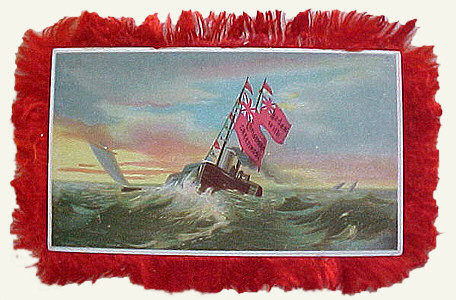
"Laden with Christmas Greetings" c.1895.
Christmas on board Her Majesty's Ship 'Ajax'. Guard-ship at Kingstown.
There were great doings on board this man-of-war on yesterday. Between decks was gaily decorated with holly and ivy, and the tars, with their wives and friends, who were present, were plentifully supplied with the best of Christmas fare. The various messes groaned beneath the weight of roast beef and mutton, with their necessary appendages, and plum puddings. To a stranger a coup d’oeil at the whole scene must have been wonderful. Jack was in his happiest mood, and the merry repartee passed from stem to stern in right good fellowship. After the debris of the dinner were cleared away and the usual loyal toasts drunk, the fun commenced. In the exuberance of their joy they carried Lieutenant Wilkinson round the ship, wishing “a merry Christmas and a happy new year” to their favourite, and afterwards chaired some of the petty officers. In almost every available corner there was a fiddler, and the honest and noble-hearted fellows footed it to their hearts delight, with some fair partner from shore, and many a sly salute was taken under the ivy, in the absence of the mistletoe. Everything went off with satisfaction, and it is our pleasing duty to state there was not a single instance of drunkenness to mar the festivities. An “open gangway” was the order of the day; the seamen could go on shore without asking leave. On board some men-of-war that are fully manned the whole discipline of the ship is entirely turned upside down on Christmas Day. It is not an uncommon thing to see a veteran boatswain lowered to a second class boy for the day, and one of these youngsters strutting about ship giving the word to scrub deck or coppers, or caning a captain of the fore-top, or other petty officer, if he did not sweep the deck properly. A happy new year to the stalwart sons of the ocean. (1)
A turn of Phrase. By Eamonn Bermingham. RIG OUT; To be dressed up. To fit out a vessel ready for sea, Now commonly used to refer to one’s clothes (i.e. nice rig out)
FIRST RATE. Used today to mean ‘of top quality’ Derives from the Sailing Navy method of classifying their sailing warships depending upon their number of guns, i.e. First Rate, Second Rate etc.
SQUARE MEAL. Originates from the fact that meals aboard Royal Navy Men of War were eaten from square plates.
HARD PRESSED. To be under pressure. When a sailing vessel has all sails set and is being strongly pushed by the wind.
BRASS MONKEY. There are two versions – A brass monkey was a cannon made from brass. Because it contracts at a different rate to the iron cannon balls (with the result that the ball will not fit the Muzzle) thus rendering the gun unuseable. According to others a monkey was a brass rack for storing cannonballs, which shrank in very cold weather causing the balls to be ejected. Hence it could be cold enough to freeze the balls of/off a brass monkey.
TO KNOW THE ROPES. To know what one is doing. Concerns itself with a Sailors ability to locate the myriad of ropes, lines and sheets aboard a sailing vessel.
THREE SHEETS to the WIND. To be drunk or scatterbrained. The sheets referred to are the lines (ropes) which control the sails of a vessel, ‘sheets to the wind’ mean they are flapping in the wind uncontrollably.
BLAZER. Comes from a Captain Washington in the Royal Navy who wanted his crew to be similarly dressed so had jackets made for them in the 1840’s. The ship’s name was the H.M.S. Blazer.
POSH. There are two versions. One refers to wealthy people traveling to the orient or colonies, booked their cabins to be on the relatively cool side of the vessel when the sun is at its hottest (in the afternoon), i.e. outward bound on port (left) side and returning on starboard side. P.O.S.H. – Port Out Starboard Home was allegedly written on the ticket. The other version, possibly more accurate, may allude to the Gypsy slang word for a ‘dandy’ and ‘Money’ (4) |
A FATAL DECISION.
R.N.L.I. Silver Medal Award. HENIN, PIERRE, Mariner.
31st. August 1833. The chartered convict ship 'Amphritrite', en route from Woolwich for New South Wales with 108 female prisoners, 12 children, a Surgeon, his wife and a crew of 14, was overcrowded and undermanned when she ran into a violent gale off Dungeness, Kent. The ship was carried across the Channel to the French coast near Boulogne, Department de Calais. In view of her helpless state, the Captain ran her ashore at 4.30 p.m. on a spit of sand three-quarters of a mile from the shore hoping to refloat her on the next tide. Onlookers and officials ashore were at best apathetic, but a local pilot ran his boat close to the casualty and offered assistance. The Captain, fearful that some of his charges might seize the opportunity to escape, refused.
Nothing further happened until 6.30 p.m. when Mr. Henin who was a strong swimmer, stripped off on the beach and entered the water with a rope. However the Captain obstinately refused to allow it to be used and the exhausted swimmer had to return to the shore. Finally, just after 7 p.m. the ship broke up with her crew in the rigging and everybody, except three seamen, perished. A total loss of 133 souls.
Monsier Henin was also awarded 250 francs (then equivalent to £10 ). The local Pilot also received 250 francs. (6)
Isle of Wight Smuggler.
The coxswain of the first lifeboat at Brighstone, I.O.W. in 1860 had been a notorious smuggler- James Buckett- who had just completed nearly five years compulsory service in the Navy as a punishment for his crimes. Now a reformed man, Buckett proved to be a fine leader, and a seaman of great skill and courage. Ironically his first rescue was the barque ‘Cedarine’. Aboard were 191 convicts homeward bound 17 days from Bermuda to Portsmouth. She came in the Grange, Brighstone, close by the life-boat station. It was high water and she grounded in the sand 20 yards from the cliffs. The lifeboat was quickly launched and landed four women and 18 children, families of the officers, and the convicts were landed by means of ropes thrown on board. The vessel sustained no structural damage, but she eventually broke up. The convicts were on their way home to be discharged, and therefore had no reason to rampage through the countryside, as has been claimed by some journalists. Nevertheless, in the confusion of coming ashore it was found impossible to keep them together At the approach of dawn they set off in gangs to explore the country after so long an absence. They were very hospitably received by the Islanders, but troops were sent and the convicts were rounded up. (8)
My grandmother, Ada Blanche Ryan HOLBRY, was born on the 24 September 1889, at Ventry, Dingle. Her father, Joseph Blake HOLBRY (1852-1934) was a coastguard, and had married a local girl, Isabella Rose RYAN (1861-1943)
Grannie used to tell us may exciting tales of her girlhood in Ireland. How she and her friends used to find flatfish in the mud by feeling with them with her feet; how she kissed the Blarney Stone - hanging upside-down, held by the ankles in the days before the health and safety legislation. Then she would bring out a heavy walking stick, a momento of coastguard days. She would then tell of enemy ships which appearing on the coast in 'The Great War' (World War I). She would then pull the handle of her "tuck stick" to reveal it's heavy, steel sword blade - and pointing to a stain on the blade announce to our horror, " ... and that's from the blood of the enemy!" Thrilling stuff to us children!
My memory of these stories is clear - but did grannie romance a little? At the time of World War I she was married and living in Cornwall - so where hostile incursions made on the Irish coastline long before 1914 - perhaps to seek out likely ship refuelling bases? (9)
I don't know which station they were at in Wexford but this story may point to it. My Grandmother used to tell about the day she was almost stranded on a desert island. It appears that when she was a small child, she and her elder brother were playing in a boat at a jetty. The rope became unfastened and the boat was swept out to sea with the two children on board.
Someone spotted them and gave the alarm. Great Grandfather had to get the men together and they put to sea in another boat to rescue the children before they were swept onto rocks. She called them the Tusker Rocks and I checked the Internet to confirm they are located of the coast at Wexford harbour.She also spoke of shipwrecks on the Tusker Rocks and I remember well that a Great Aunt had a large burnished copper kettle that had apparently been washed ashore from one of these wrecks.
Another story from this part of the world involved an old woman who was a beach comber and she used to forage for wreckage. One day a decomposed seaman's body was washed up on the shore complete with a pair of seaman's boots. The old woman pulled the first boot off without difficulty but when she tried to get the second one off she had problems. She pulled and pulled again and then pulled so hard that the boot with the leg still inside came away. She let out a shriek and ran off as fast as she was able to. It was some time before she ventured back on the shore. (5)
|
|





 Posted by Tony
on June 17 2007
Posted by Tony
on June 17 2007



 Henry Bray, Chief Officer, Gr...[6831]
