A more amusing incident took place on the night of 10 November 1884. On that day a wedding had taken place in Ballywalter village and in accordance with local custom a bonfire was lit in the evening. It so happened however that the fire was in line with the Long Rock, the scene of many shipwrecks, and the South Rock Lightvessel, some 5 miles distant. The Lightshipmen on seeing the fire concluded that the Long Rock had claimed another victim and immediately began to shoot rockets in the air and fire the gun to attract the attention of the Coastguards. This roused the inhabitants of the village and surrounding district causing great excitement. The rockets continued until the fire died out, when the error was discovered and the firing stopped.
| Link Removed | | Link Removed | | Link Removed | | Link Removed | | Link Removed |

Wit & Wisdom of Ireland.
Oscar Wilde describes a genealogist as "A person who will trace your ancestors as far back as your money will go"
|
| Coming in May Edition What a Lovely Window.
| | forum. |
|
Dear Friend,Welcome to the April edition of "The Coastguard Cutter". Another Mystery Man. In the December 2003, issue of the Coastguard Cutter we told you about a Mystery Man on the walls of a Coastguard station on the East coast of Ireland and showed his photo. A short while ago we had a letter from a reader who wondered if his "Mystery Man" and our man were one and the same. Unfortunately they were completely different men at different stations. However this is another good story for our News-letter. Enjoy,
Tony.
| Mystery Man Letter I came on your web site by accident and I was intrigued about your article on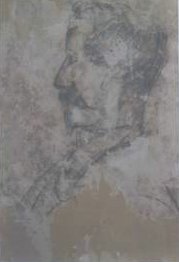 “the Mystery Man” at an unnamed County Down coastguard station (Newsletter December, 2003). My great grandfather was William Stanbury who was the officer in charge of the coastguard station at Burr Point, in County Down around 1901. My grandmother was a great story teller and could keep people enthralled for hours. One of her stories involved an incident she claimed happened at Burr Point. The father and mother had gone out one evening leaving the seven children in the house. “the Mystery Man” at an unnamed County Down coastguard station (Newsletter December, 2003). My great grandfather was William Stanbury who was the officer in charge of the coastguard station at Burr Point, in County Down around 1901. My grandmother was a great story teller and could keep people enthralled for hours. One of her stories involved an incident she claimed happened at Burr Point. The father and mother had gone out one evening leaving the seven children in the house. She described how they were cooking seafood in a pot and then had to carry the pot from a kitchen to another room. On the way they had to pass a staircase leading downstairs into some form of hallway or passage leading to an outer door that was locked and bolted. She claimed that although the passage was dark they saw a very tall man dressed in black, walk across the passage at the foot of the stairs and disappear through the wall. The outer door was still locked and there was no other exit. The children were frightened, spilled the food and then locked themselves in one of the upstairs rooms until the mother and father came home. Of course by the time the parents came home the only evidence was the spilled food on the floor. One of my great uncles came to stay with us for a summer holiday. He was an old sailor and also a great story teller. He was the eldest child and was sixteen or seventeen when 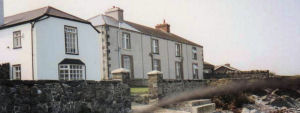 the incident happened. He also told the story and it was an exact repeat of my grandmothers’ version. Another brother and sister independently verified the story at different times. I do not know who or what they saw but it is evident to me some 50 years on from hearing the story that they certainly believed they had seen a ghost or “mystery man”. I wonder if the coastguard station in your article was the one at Burr Point? (1) the incident happened. He also told the story and it was an exact repeat of my grandmothers’ version. Another brother and sister independently verified the story at different times. I do not know who or what they saw but it is evident to me some 50 years on from hearing the story that they certainly believed they had seen a ghost or “mystery man”. I wonder if the coastguard station in your article was the one at Burr Point? (1)
| Mystery station- Front door demolished.
Another little Mystery has just come my way. Maybe some of our readers may be able to solve this one. There is an account of an action involving a Royal Navy vessel which (on purpose) fired a 'shell' through the front door of a Coastguard station in Ireland. But which station ?.
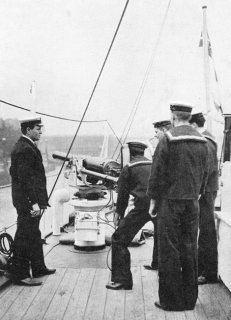 | We were involved in one engagement with Sinn Fein. This was after the Truce when Irish were murdering Irish. We had occasionally delivered mail to a member of the new Senate who lived on the shore of the Kenmare river. We anchored off and sent in our dinghy with outboard , with an officer and one seaman. I was still on the bridge when the dinghy was on its way in. There was the sound of shots and I saw them splashing in the water around the dinghy, which McLean quickly turned round and headed back. As the shots went on, I aimed the twin Lewis gun mounting on the bridge wing into the trees above the boat and let loose one burst. That stopped whoever was shooting. We thought we might try to parley with our attackers and moved the ship opposite an evacuated Coastguard station, which we had reason to believe was their headquarters. The men were at tea and the Captain, First Lieutenant, Chief Engineer and myself were having a cupper in the ward-room discussing what to do next. Suddenly there was a noise like hailstones on a corrugated iron roof. | Navy gun -1922 / 1923 |
Our friends had opened up on us with a machine gun. I got up to the bridge, but we were out of effective Lewis gun range, and so I dropped over the front of the bridge to the forward gun platform where I found a stoker petty officer sheltering in the gun shield.
The gun had been left with a shell in the breach. I finished loading, brought it to the ready, took gun layer and directed the SPO who took trainer, and we put a shell through the front door of the Coastguard station – a good shot. What effect it had apart fro stopping whoever was shooting at us, we never heard. Our only casualty was the Chief who got a splinter off one of the guard rails in his trouser leg as he dived for the engine-room ladder from the ward-room. This drew blood but only just. We reported this ‘battle’ to Queenstown and were told not to try to deliver the senator’s mail.
Commander B.De L’Faunce sailed on the HMS Badminton, a minesweeper, which was engaged in coastal patrols off Ireland, mainly in supply and and support role to Coastguard stations, but also targeting possible gun smuggling. (2)
FUNDING TIDE TURNS FOR THE MARITIME MUSEUM. 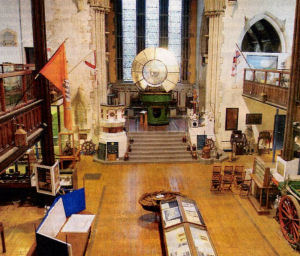 The Government has awarded € 1.5 million towards refurbishing the historic Mariners Church in Dun Laoghaire, Dublin. The early 19th-century church houses the National Maritime Museum, which is run voluntarily by the Maritime Institute of Ireland. The Government has awarded € 1.5 million towards refurbishing the historic Mariners Church in Dun Laoghaire, Dublin. The early 19th-century church houses the National Maritime Museum, which is run voluntarily by the Maritime Institute of Ireland.
The grant through the Office of Public Works represents the first State funding in 15 years for the building which is in a very fragile state.
The rotating optic from the Bailey light-house in Howth is a worthy addition to its treasures. A small band of people, steeped in the history of the seas around Ireland, and dedicated to maintaining the contents of the museum can now look forward to a brighter future for the Museum.
|
|
|






 Posted by Tony
on June 17 2007
Posted by Tony
on June 17 2007



 Henry Bray, Chief Officer, Gr...[6831]
