

View Thread
 Alexander Forsyth - Kingstown Coastguard Vessel HMS Ajax
|
|
| Bforsyth |
Posted on 30/01/2009 14:01
|
 New Member  Posts: 2 Joined: 30/01/2009 |
Can anyone guide me as to where I can find the service records of Alexander Forsyth (Kingstown Coatguard Vessel HMS Ajax)? His name is listed on the Boyd Monument on Dun Laoghaire East pier. I am interested to find if he is in some way related. |
|
|
|
| crimea1854 |
Posted on 30/01/2009 14:27
|
 Administrator  Posts: 906 Joined: 09/07/2007 |
Hi, and welcome to the Forum. Can I suggest you follow the link below, maybe one of these men is who you are looking for. http://www.nation...5Fdate+asc If not, I'm afraid you will have to try tracing your mans service history using the ADM 175 series of records. Regards Martin |
|
|
|
| crimea1854 |
Posted on 30/01/2009 15:12
|
|
Administrator Posts: 906 Joined: 09/07/2007 |
Since posting the above reply I've been looking at the story surrounding the death of Captain Boyd, of HMA Ajax. None of the above service records can be your man, because they are all prefixed ADM 188, which indicates that they date FROM 1873. Since Boyd and Forsyth drowned in 1861 these men must be excluded. I've also consulted the English and Irish indexes to ADM 175 and cannot find an Alexander Forsyth. However, if you could get to the National Archives at Kew, there does appear, from the Catalogue, to be a Description Book in the ADM 38 series (ADM 38/7476) for HMS Ajax that covers the period 1858 - 1864. If Forsyth was a member of the crew, he should be listed together with his place of birth, age, physical description and prior service history. Regards Martin |
|
|
|
| Bforsyth |
Posted on 02/02/2009 13:59
|
|
New Member Posts: 2 Joined: 30/01/2009 |
Martin......thank you very much...very helpful indeed. I hadn't considered heading over to Kew but I might have to if I am to resolve this. The other option is to locate the Carrickbrennan (Monkstown) burial records. There is a monument in the graveyard to those who perished but I am not too sure as to who is buried there. |
|
|
|
| Tony |
Posted on 03/02/2009 13:04
|
 Administrator Posts: 136 Joined: 28/04/2007 |
Extracts from the Times newspaper (FROM OUR OWN CORRESPONDENT.) DUBLIN, SATURDAY EVENING [Tue 12 February 1861] MELANCHOLY CATASTROPHE AT KINGSTOWN. Intelligence reached town this afternoon that Captain Boyd, of Her Majesty's ship Ajax, and 14 men of his crew, were unfortunately drowned about 12 o'clock to-day outside Kingstown Harbour. A telegram received states that- "Captain Boyd with his men were standing on the Eastern Pier, endeavouring to save the crew of a vessel which had gone ashore at the back of the pier, when a wave swept them all into the sea. Mr. John Mulvany, architect, was with them, but was saved. "KINGSTOWN, 2 30 p.m. - As far as can be ascertained, 16 vessels have gone ashore in or about Kingstown Harbour. Many lives have been lost in addition to those of Captain Boyd and boat's crew."Last night, about 9 o'clock, one of the severest gales remembered in Dublin for many years set in from the south-east, and continued to rage up to an advanced hour to-day, accompanied by heavy rain and sleet. In addition to the sad disasters at Kingstown already detailed, numerous shipwrecks have occurred along the eastern coast, in the neighbourhood of Dublin, and it is much feared that the destruction of life and property has been considerable. MONDAY MORNING. THE RECENT STORM. The ravages committed by the gale of Friday night and Saturday forenoon are much more serious and extensive than the uncertain accounts received in town during Saturday led one to expect. The papers of this morning have each several columns devoted to the records of the disasters which have occurred at various points along the Eastern coast, from Bray in the South to Drogheda in the North; but as yet it is impossible to estimate closely the number of lives lost or of the vessels which have foundered or been broken to pieces. The Freeman's Journal, in an article on the storm, observes:- "The storm that wrecked the Royal Charter was one of the most violent, for its duration, within the last 20 years. Great damage was the consequence, besides the loss of a noble ship, large property, and many valuable lives. The storm of Friday night and Saturday was still more violent and destructive in its ravages. No phenomena indicated any unusual interruption to the fine weather that prevailed during the last few weeks, which reminded one of the softness of April rather than the harsh and tempestuous days of February; but in the afternoon of Friday the barometer took a sudden turn and rushed down, while the weather-vanes whirled violently between north and east. At midnight, or a little earlier, the storm set in with frightful fury, and raced without intermission until late in the afternoon of Saturday. It gradually subsided towards nightfall, and, though high wind prevailed during Saturday night, it did not approach in fury the storm of the morning. Though the wind blew from between north and east, and more to the north than east during its greatest violence, yet the rush frequently took a wider compass, and appeared to come from the south and west. The storm was or the true cyclonic character, and, as had been anticipated, accompanied with frightful losses, All along the coast we hear of lamentable disasters, but the complete loss will not be known for some days." The most melancholy of the numerous disasters recorded is decidedly the death of Captain Boyd and his boat's crew, mentioned in my despatch of Saturday. The reporter of the Freeman's Journal gives some details in reference to this event, which I subjoin:- "Kingstown, Sunday Night, "It is too true about the fate of poor Captain Boyd, of Her Majesty's ship Ajax, and his gallant companions. They are gone - lost in their humane efforts so save the lives of their brother sailors. Captain Boyd, you are aware, was an Irishman -I believe a native of Derry. During his sojourn among us he gained the esteem of all for his many good qualities. A nobler fellow never trod the deck - beloved by his officers and men. The particulars under which he came to his death are as follows:- Three large brigs were perceived drifting in towards the rocks at the back of the East Pier, near to a short breakwater that was run out some time ago. Captain Boyd at once observed their perilous situation, and, with the true spirit of a sailor, immediately summoned his men to man boats for the pier. They landed, and at once proceeded to the other side of the pier, where the vessels were drifting. The vessels came on and were smashed on the rocks. The shrieks of those on board were heard far above the tempest. Ropes were thrown towards them, but they were driven back by the force of the storm. A mortar was used to throw a line, but it was utterly useless, the wind being too strong. The poor sailors were then seen to throw themselves overboard, and met with instantaneous death. Some of Captain Boyd's men procured ropes, lashed themselves with them and plunged into the surf, to endeavour to get on board either of the ill-fated vessels, but tho sea was too powerful. At this time a large number of people collected, all willing and able to assist, but their good intentions were powerless. Their fellow-creatures were drowning before their eyes at a few yards' distance, and nothing could be done to save them. Captain Boyd saved a few of his own men from death by pulling them out of the surf. It was at this time, 12 o'clock noon, blowing fearfully. At last there was a treacherous lull, and an enormous wave came round the point of the breakwater on which he and his brave crew were standing, and, as it receded, swept all that were there into the sea-the gallant captain and his courageous crew were seen no more. Others who were standing as spectators narrowly escaped death; fortunately they were extracated in time from their perilous situation by others. A man named Anderson, who was standing within a few yards of Captain Boyd, got his thumb jammed between the rocks, and thus was miraculously preserved to his family. Those who escaped were bruised and otherwise wounded by the rocks. Tho doctors of the town dressed the wounds, and those sailors who were injured were immediately taken on board the Ajax, and attended to by Dr. Buchanan, the surgeon of the ship. This gentleman broke the sad intelligence of the fate of poor Captain Boyd to his wife, who resides on board." NAVAL AND MILITARY INTELLIGENCE. [Wed 13 February 1861] A letter received at Plymouth from the Ajax, at Kingstown, says:- "On Friday, the 8th, the weather was very rough, but not stormy; the wind north-east, and right in for the harbour. A brig tried to go out but could not, and in tacking went ashore close to the lighthouse. We saved all the men, but the vessel was dashed to pieces; she was laden with salt. On Friday night it blew very heavily from north-east and on Saturday morning we could not see a particle of the wreck. The mail steamboat Leicester tried to go to Holyhead, but had to put back, having been nearly lost in the gale. It was dreadful to see the waves. Some dozen vessels at sea endeavoured to put in for shelter; all but four succeeded. The first, a fine brig, ran on the rocks 500 yards from our ship. Our people were all on shore trying to save the crew; they saved one man, the master; all the rest, five, were drowned. At the same time another vessel ran on the rocks close to the first. She was lost, and three men out of five were drowned. A third vessel was driven ashore, but the crew escaped. The rocks were all crowded with our men, trying to help the crews of the wrecked ships, and a lot of people from the town were looking on. I cannot describe properly what occurred, but a sea like a mountain came and washed every one off. Many were carried up on the land, and drawn back again by the waves. How many were drowned we cannot tell as yet, but we have recovered nine bodies, some from under stones a ton weight. Twenty-one townspeople were lost that we know of, and we expect there were more. Our loss from tho Ajax was Capt. Boyd, John Curry, seaman; James Johnson, A.B.; John Murphy, seaman; A. Forsyth, A.B.; and John Russell. The captain's body is not yet found. Our gunner, Mr. Farren, is much cut by the rocks, and a dozen more are in the same condition; they are all in bed. Our ship is very sad and lonely. The gale is all over now. There have been thousands of people from Dublin to see the place where the wrecks occurred and where our sailors were lost." Captain Boyd's Funeral [ Tue 5 March 1861] The remains of the lamented commander of the Ajax were consigned to their resting place in St. Patrick's Cathedral yesterday, amid extraordinary demonstrations of respect from the people of all classes. Memorial on the East Pier, Dun Laoghaire. 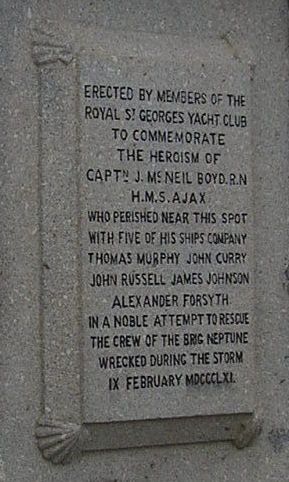 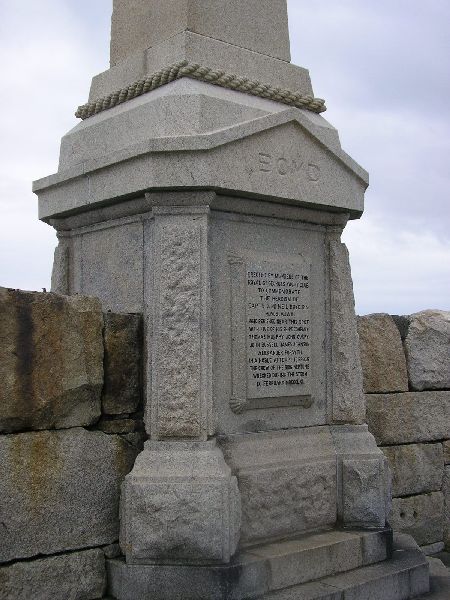 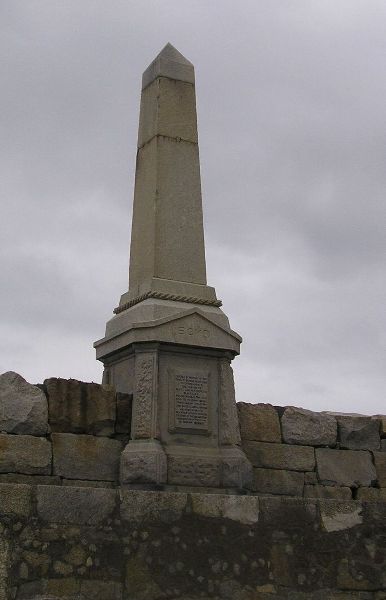 |
|
|
|
| willoughr |
Posted on 19/02/2009 20:41
|
 Member  Posts: 46 Joined: 03/05/2007 |
I have some notes from the log and musters of the Ajax. Alexander Forsyth was a sailor aboard HMS Ajax (I don't have a note of his precise rank). According to the ship's log book his body was recovered at 10.15am on Wednesday 13 February 1861. He was owed £7.3s at the time of his death. His effects were sold for 9s 8d. From this the navy deducted £4.19s 4d due for various necessaries, with the balance of £2.13s.4d being available to remission to his family. Regards Roger Roger Willoughby
|
|
|
|

| Jump to Forum: |


