View Thread
 Obtaining coastguard/Naval records from Kew
|
|
| MEG |
Posted on 06/09/2008 02:21
|
 New Member  Posts: 1 Joined: 01/09/2008 |
I am interested in obtaining the naval records of Lt. Charles Shortt RN, Chief Officer, coastguard Ballycastle, Antrim, 1831-1842 I would like to hear from anyone who has had experience hiring a researcher to obtain these sorts of records or anyone who could advise about alternate ways of obtaining the information. I have searched "documents on line" and the Catalogue on the National Archives web site and no matter how I configure the query Lt. Charles Short(t) never turns up for me. Any advice would be welcome. |
|
|
|
| crimea1854 |
Posted on 06/09/2008 11:16
|
 Administrator  Posts: 906 Joined: 09/07/2007 |
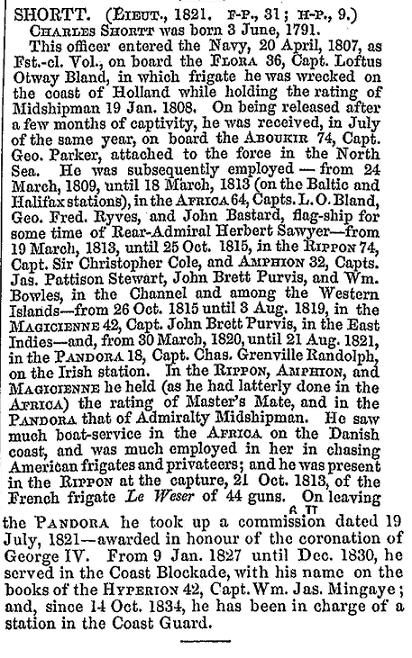
Hi Meg, and welcome to the Forum. This is outside my normal time period for research, but I hope the following will be of some help. Having looked at a number of websites I have put together some information on Charles Shortt. Born 3rd June 1791, he entered the navy on the 20th April 1807, of more importance to you is to know that Shortt passed his Lieutenants exam on 19th July 1821. The importance of this event is that to pass, in addition to the exam, an applicant had to submit details of past service, which for a Lieutenant meant at least six years prior service. The passing certificates and details of past service can be found at the National Archives, Kew. These particular records have been indexed by Bruno Pappalardo (Royal Navy Lieutenants’ Passing Certificates 1691-1902), this index can be consulted at the NA and could save you a considerable amount of time. There are references to Shortt in the Navy Lists of 1843, 1844, 1847 & 1848, at which time he was a Chief Officer in the Coastguard Service – there may be others but I do not have access to them. Finally, O'Byrne's produced his Royal Navy Biography’s of 1849; this consists of biographies for every officer then serving in the Royal Navy. Having consulted the index Charles Shortt does have an entry. If you could get access to a copy of this book, it may contain some of the information you seek. Hope this has been of some help. Regards Martin |
|
|
|
| crimea1854 |
Posted on 06/09/2008 13:54
|
|
Administrator Posts: 906 Joined: 09/07/2007 |
Margaret I could not find a way to attach an image to a PM via the Forum so I've resorted to using the open Forum: I did not come back to you earlier because I was awaiting the response of another medal collector, who specialises in the Napoleonic War period. I am able to save your son a trip to the library, because I now have a copy of Shortt’s extract from O’Byrne – see attached. As I stated in my reply this is not my period – I can’t afford it!!! My interest is in the Navy at the time of the Crimea. However, over time I have built up a number of useful websites that are now in my favourites box; it was these that I consulted to try and answer your question. Kind regards Martin
crimea1854 attached the following image:
|
|
|
|
| crimea1854 |
Posted on 06/09/2008 14:17
|
|
Administrator Posts: 906 Joined: 09/07/2007 |
I hope Tony will forgive me, because we are getting a little away from Coastguards here, but this does provide an insight in to the career of a man before entering the CG service. This so excited my fellow collecter that he has since sent me the following which relates to some of the events in Shortt's life: Some information on the Weser incident and Rippon's involvement: On 30 October 1813, some 15O miles west of Ushant in very squally weather, ROYALIST came across Capt. MACDONALD in SCYLLA who was shadowing a French national frigate WESER, Cap. de Vaiseau Cantzlaat, which was under jury rig after being dismasted in a gale. In the afternoon the two brigs, SCYLLA on her quarter and ROYALIST on her bow started an action which continued for an hour and a half until they were forced to haul off repair their rigging. Down wind of them was a man-of-war, RIPPON,74, and Capt. BREMER sailed to her at 3 A.M. to apprise Capt. Sir Christopher COLE of the enemy's force. The following morning a breeze came up and enabled RIPPON to close and the French frigate struck her colours. Since the prize was in a badly damaged state Capt. COLE took off most of the prisoners and towed her into port. The two 44-gun French frigates WESER and TRAVE had left the Texel on 3O September to sail round the north of Scotland and both were dismasted in the same gale on the 16th after WESER had captured two Swedish vessels. TRAVE had an exchange of fire with ACHATES before being captured by ANDROMACHE on the 23rd and taken into Cawsand Bay. ROYALIST had two men killed in the action:- Joseph SANGTER, able seaman, and Cornelius RALT, ordinary seaman. Five were severely wounded including the master, Mr W. WILSON, and four others, including the first lieutenant, Mr J. WARING, slightly wounded. And some info on his commission in HMS Africa 1808-13: Capt. John BARRETT, 8/08. 0n 18 August AFRICA was attacked off Copenhagen by 12 gunboats and had to retreat into Malmo. AFRICA and the THUNDER, bomb, and two brigs sailed from Karlskrona on 15 0ctober with a homebound convoy of 137 merchantmen. Early on the 20th she anchored to allow the other ships to escort the convoy into Malmo, losing four on the way. About midday she was discovered by nineteen Danish gunboats and three mortar boats and, with no wind, the enemy were free to attack from the bow and stern where her big guns would not bear. The action lasted for more than three hours when, with increasing wind and approaching darkness, the Danes retired. AFRICA lost 9 killed and 53 wounded and had to return to Karlskrona for repairs. The Danish losses were 28 killed and 36 wounded. The remainder of the British fleet sailed for home on 25 0ctober and reached the Downs on 8 December 1809 Capt. L. 0'BLAND, 4/09, late of the FL0RA which had been wrecked on the Dutch coast in January. AFRICA was to be anchored in the Baltic as a protection to British trade. Capt. Thomas DUNDAS, 9/09. 1810 Capt. George Frederick RYVES, 3/10, North Sea - Baltic, where AFRICA took part in the blockade of Copenhagen. In 0ctober a boat under the command of Lieut. FINNISNERE destroyed a Danish privateer on the Falstubo Reef. Capt. RYVES escorted 200 merchantmen through the Great Belt during a gale without losing a single vessel. After delivering his convoy to Yarmouth he experienced a severe gale in the Channel while on passage to Portsmouth. Against the advice of his pilot he resolved to anchor and AFRICA rode out the gale in comfort for four days. In 0ctober 1810 Capt. RYVES was appointed to MARS and Capt. CARDEW was appointed to AFRICA. The first lieutenant, Mr John H. MARSHALL, along with 19 other lieutenants was promoted to cxommander on 21 0ctober in commemoration of Trafalgar. 1811 Capt. John b*st*rd, 11/10, Falmouth for Halifax as flagship of Rear Ad. Herbert SAWYER. The frigate BELVIDERA escaped from an action with an American squadron off New York on 23 June and brought news of the war to Halifax three days later. 0n 5 July Ad. SAWYER despatched a squadron consisting of SHANN0N, Capt. Philip Vere BR0KE, BELVIDERA, AFRICA and AE0LUS on a cruise and four days later they were joined by GUERRIERE. 0n the 16th they captured the U.S. brig NAUTILUS despite her desparate efforts to escape, even throwing her lee guns overboard. The following afternoon the squadron gave chase to a strange sail which proved to be the U.S. frigate C0NSTITUTI0N,44, which had sailed from the Chesapeake on the 12th. 0n the morning of the 18th GUERRIERE, approaching C0NSTITUTI0N, signalled to the remaining British ships but, getting no reply, assumed them to be American so wore round and stood away. Two hours later the wind dropped and soon all the ships were towing. SHANN0N, with nearly all the squadron's boats pulling her, managed to exchange a few shots with the enemy, but C0NSTITUTI0N by towing, warping with the kedge anchors and finally sailing, managed to reach Boston on the 26th. AFRICA had been left far behind in the chase. AFRICA returned to England in 1813 and the following year she was at Portsmouth waiting to be broken up. Martin Edit: Moved to Coastguards
Edited by Philip on 14/09/2008 13:58 |
|
|
|
| ianhmcn |
Posted on 07/10/2008 16:50
|
|
New Member Posts: 2 Joined: 14/09/2008 |
A question for Martin But First may I say how much I think this site can contribute to finding out about Coastguard ancestors. My main interest is with stations in England and Scotland but I do have a slight interest in a John Hartridge who was in Waterford around 1855. He was marrid to the daughter of my gr gr gr grandfather Thomas Hughes who was Chief Officer at Johnshaven in Kincardineshire Scotland from 1825 to 1840 something. Now my question In message 2 you produced a great deal of information about Charles Shortt from websites, could you briefly indicate which sites you accessed to produce this information so that I could try to use these to add to my knowledge of Thomas Hughes? Thank you Ian |
|
|
|
| crimea1854 |
Posted on 09/10/2008 19:03
|
|
Administrator Posts: 906 Joined: 09/07/2007 |
Hi Ian Your question is a little difficult to answer because it depends what information you looking for. Below I have listed what I consider to be the top three sites, which cover most areas of RN and Coastguards research. http://www.genuki...index.html http://www.pbenyo...Naval.html http://www.angelf.../Site.html Regards Martin |
|
|
|
| ianhmcn |
Posted on 09/10/2008 21:45
|
|
New Member Posts: 2 Joined: 14/09/2008 |
Martin Thanks for the reply. Guess where you will find me for the next goodness knows how long. Ian |
|
|
|

| Jump to Forum: |